Pontiac Firebird

Meet Chandler
Chandler has a bachelors and masters degree in history as well as a passion for classics and muscle cars. His education and historical knowledge makes him skilled at crafting highly detailed articles about America’s muscle cars and automotive history. His love of muscle cars is undeniable, with him seeking them out at every opportunity during his visits to auto shows and car meets. Chandler’s knowledge and enthusiasm towards automotive history make him a great asset to the Muscle Car Club community.
The Pontiac Firebird stands out as one of the most iconic pony cars of all time. Pontiac introduced the Firebird in 1967, and kept it around all the way until the new millennium in 2002. The Firebird earned a reputation as one of the most potent pony cars around, and it led the way for performance in the 1970s. Pontiac introduced the Trans Am option package in 1969, but it eventually became its own model the next year. The Trans Am sold incredibly well, at times selling as many units as the other three trims combined.
The first two generations of the Pontiac Firebird span from 1967–1969 and 1970–1981. The second generation ended in 1981, with the third generation kicking off in 1982. Read on for more information about the first and second generation 1967-1981 Pontiac Firebird, or check out our other article for the third and fourth generation 1982–2002 Pontiac Firebird.
1967-1981 Pontiac Firebird Overview
Pontiac created the Firebird in 1966 to coincide with the Chevrolet Camaro, as General Motors’ entry into the pony car market. At the time, the market was dominated by the Ford Mustang and to a lesser extent the Plymouth Barracuda, and the entry of the Camaro and Firebird easily started cutting into Ford and Chrysler’s bottom-line.
The first generation Pontiac Firebird lasted from 1967–1969, and had engine options ranging from a 230 cid inline-six to a big-block 400 cid V8. Performance was outstanding for the Firebird, and at a $2,700 cost for the coupe it was a great deal. Pontiac offered the Firebird as either a convertible or a coupe, and it resided on GM’s F-body – which it shared only with the Camaro.
Often compared with the Camaro, the Firebird looked visually very similar and had similar engine options, too. However, there were minor stylings that set the two apart, including badges and decals, and the Camaro got the larger and more powerful engines. The Firebird also had the Trans Am package beginning in 1969, which really made it stand out from the normal F-bodies.
The second generation of the Pontiac Firebird lasted from 1970–1981. By now, Pontiac had established the Firebird as a serious pony car, and it reached a high in popularity in 1979. Unfortunately, things quickly fell apart, and the generation ended in 1981 with its worst year for sales since 1973.
Today, the first and second generation Firebirds are some of the most sought out on the collectors market. A 1969 Pontiac Firebird Trans Am easily goes for north of $100,000 if in good condition, and prices skyrocket from there.
1967-1969 Pontiac Firebird
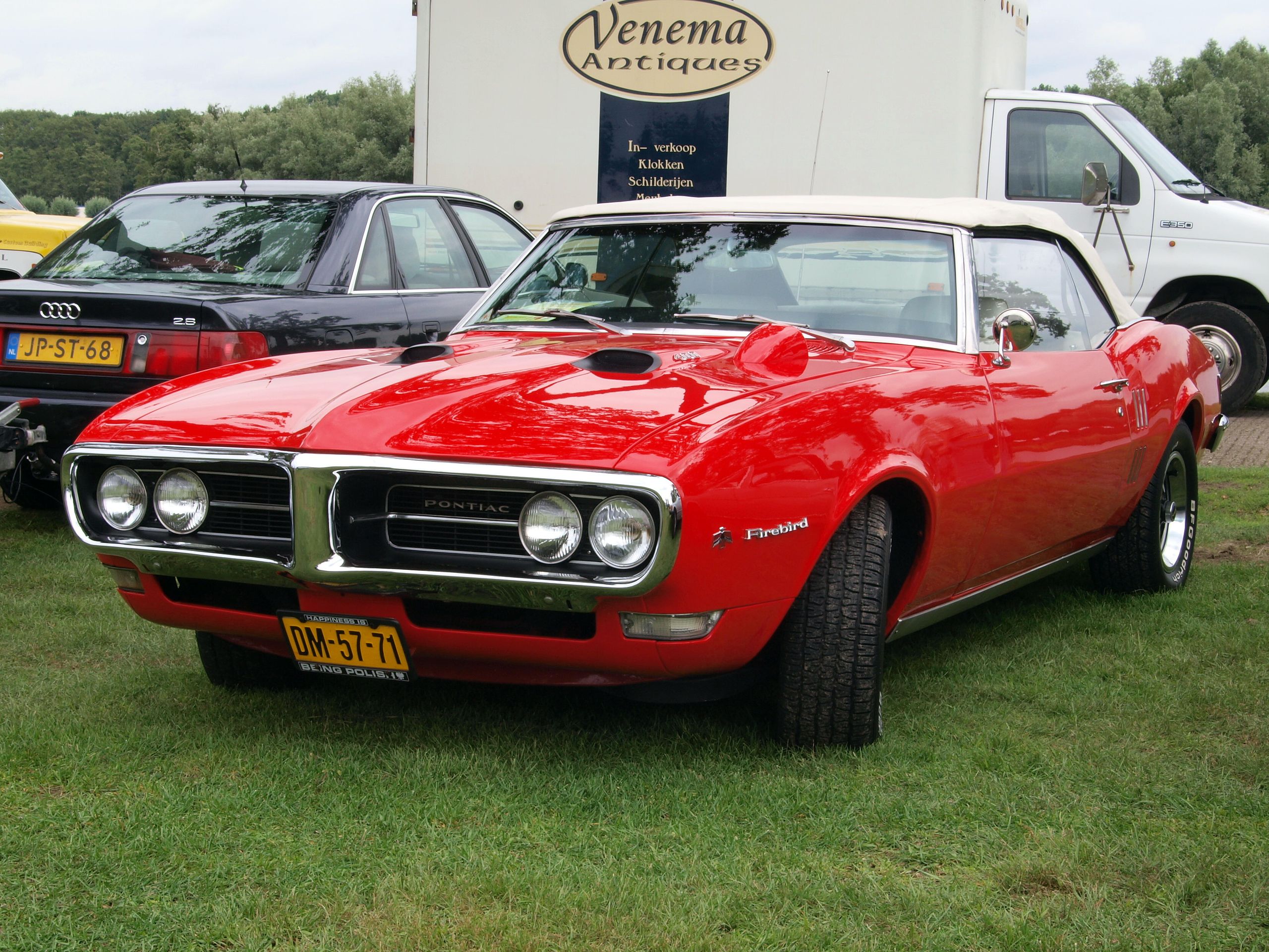
Pontiac released the Firebird on February 23, 1967, less than six-months after introducing the Camaro. They rode on the identical GM F-body platform, so pretty much everything was the same except the badging and some of the engines. The Firebird was however about $100 more than the Camaro with standard equipment. Differentiating the two was the grille, beaked hood, and GTO-style headlights.
Pontiac offered two body styles, a two-door coupe and a two-door convertible. The coupe was by far the more popular option and sold much better. Each year, Pontiac offered a number of different engines under the hood, including both six and eight-cylinders.
The 1968 Pontiac Firebird did not change much visually, with the exception of the removal of the side vent windows. For the 1969 Pontiac Firebird, the exterior got a facelift and the interior was changed. The grille and bumper were now a one-piece Lexan, and the entire car got bigger, wider, and longer.
The Trans Am
However, the biggest change was the addition of the Trans Am (WS4) option package. The Trans Am package gave you the high-output (HO) Ram Air/Ram Air IV (L74/67) 400 cid V8s, three-speed manual transmission, heavy-duty suspension, power steering/brakes, and Safe-T-Track rear.
Appearance wise, the Trans Am got functional hood scoops, front fender air extractors, hood stripes, blacked out grille, and three-spoke wood-grain steering wheel. If you got the Ram Air IV, a four-speed manual or Turbo Hydramatic four-speed auto were available.
Conceived to campaign in the SCCA’s road racing series (with a special 303 cubic inch V8 which was never offered in production cars), Pontiac paid a $5 license fee to SCCA for each Trans Am sold to use the name.
All Trans Ams were at first only available in Polar White with blue racing stripes, tail panel, and decals, but more colors were later added. The exclusive hood had functional air intakes which could be closed by the driver and functional fender scoops designed to vent the engine bay. A 60 inch rear foil (spoiler) was mounted on the trunk. Although the Trans Am was no faster than similarly equipped Firebirds, it represented the peak of Pontiac performance excitement.
First Generation Engine Technical Specifications
| Model Years | Engine | Horsepower | Torque | Engine Code |
| 1967 | 230 cid I6 (1bbl) | 165 horsepower | 216 lb-ft | N/A |
| 1967 | 230 cid I6 (4bbl) | 215 horsepower | 240 lb-ft | W53 |
| 1967 | 326 cid V8 (2bbl) | 250 horsepower | 333 lb-ft | L30 |
| 1967 | 326 cid V8 (4bbl) | 285 horsepower | 360 lb-ft | L76 |
| 1967 | 400 cid V8 (4bbl) | 325 horsepower | 410 lb-ft | W66 |
| 1967-1968 | 400 cid V8 Ram Air | 325 horsepower | 410 lb-ft | L67 |
| 1968-1969 | 250 cid I6 (1bbl) | 175 horsepower | 240 lb-ft | N/A |
| 1968 | 250 cid I6 (1bbl) | 215 horsepower | 255 lb-ft | W53 |
| 1968-1969 | 350 cid V8 (2bbl) | 265 horsepower | 355 lb-ft | L30 |
| 1968 | 350 cid V8 (2bbl) | 320 horsepower | 380 lb-ft | L76 |
| 1968-1969 | 400 cid V8 (4bbl) | 330 horsepower | 430 lb-ft | W66 |
| 1968-1969 | 400 cid V8 400 Ram Air | 335 horsepower | 430 lb-ft | L74 |
| 1968 | 400 cid V8 Ram Air II | 340 horsepower | 430 lb-ft | L67 |
| 1969 | 250 cid I6 (4bbl) | 230 horsepower | 260 lb-ft | W53 |
| 1969 | 350 cid V8 HO (2bbl) | 325 horsepower | 380 lb-ft | L76 |
| 1969 | 400 cid V8 Ram Air IV | 345 horsepower | 430 lb-ft | L67 |
First Generation Engines and Performance
For the 1967 Pontiac Firebird, there were six different power outputs available from three different engines. The standard engine was a 230 cid inline-six that made 165 horsepower. Buyers could opt for the “Sprint” version with the W53 engine code, which bumped up power to 215 horsepower (230 horsepower in 1969) with a Rochester QuadraJet carburetor.
The next step up was the 326 cid V8 with the L30 engine code, which made 250 horsepower with a Rochester two-barrel. The high-output (HO) 326 V8 (L76) made 285 horsepower through a Rochester QuadraJet and dual-exhausts.
The top dogs were the 400 cid V8s, with the W66 and L67 engine codes. The W66 had a 10.75:1 compression ratio, five main bearings, and a Rochester QuadraJet to make 325 horsepower. The L67 made the same power, but had a Ram Air package that made the hood scoops functional, used a hotter camshaft, and low-restriction exhaust manifold.
Suspension upgrades included multi-leaf rear springs with rear shock absorbers and larger tires for 1968. That year, Pontiac also stroked the inline-six out to 250 cid and added a 350 cid V8 to replace the 326. The standard 350 rated to 265 horsepower, while the HO 350 made substantially more at 320 horsepower. Compared with the year prior, all Firebird engine cylinder heads had larger valves and an open combustion chamber design. Available transmissions included a three-speed floor-shifted manual, four-speed manual, and a three-speed Turbo Hydramatic automatic.
The Ram Airs
Pontiac first introduced the Ram Air engine package for the 400 cid V8 in 1967, though it made the same power as the standard 400 at 325 horsepower. Mid-way through 1968, Pontiac replaced the original Ram Air (L67) with the slightly more powerful Ram Air II (L67), which now made 340 horsepower through revised cylinder heads, forged internals, a hotter cam, and stronger valve train.
This was the same Ram Air II that was in the Pontiac GTO, but had a restrictor to stop the QuadraJet from fully opening. This was to keep the engine with the 10-pound/1-horsepower ratio mandated by corporate. There was also another 400 Ram Air, a different 400 cid V8 that made 335 horsepower, which lasted from 1968–1969.
In 1969, there were two Ram Airs available, the 400 Ram Air and the Ram Air IV. The Ram Air IV came out that year, and was the most powerful yet at 345 horsepower. It was basically the Ram Air II, but had an aluminum intake manifold to save weight, 1.65:1 ratio rocker arms oblong instead of rounded combustion chambers, and four-bolt mains.
1967–1969 Firebird Production Numbers
| Model Year | Bodystyle | Production Total |
| 1967 | Coupe | 67,032 |
| Convertible | 15,528 | |
| 1967 Total | 82,560 | |
| 1968 | Coupe | 90,152 |
| Convertible | 16,960 | |
| 1968 Total | 107,112 | |
| 1969 | Coupe | 76,362 |
| Convertible | 11,649 | |
| Trans Am Coupe | 689 | |
| Trans Am Convertible | 8 | |
| 1969 Total | 88,708 | |
| 1967-1969 | Total | 278,380 |
Trans Am Production: Of the 689 sold, 634 had the L76 HO 400 V8, and of those 114 were manual and 520 automatic. Of the 55 Trans Ams with the L67 Ram Air V8, 9 had manuals and 46 opted for automatics.
1970-1972 Pontiac Firebird
The second generation began with the 1970 Pontiac Firebird. Compared with the year prior, the 1970 Firebird was longer, lower, and heavier. Pontiac gave it a new Endura bumper to meet federal emissions, but color-matched it to the car to make it appear bumperless.
Gone was the convertible option, but there were four trims available: the base, Esprit, Formula 400, and Trans Am. Changes for the base included manual disc brakes and a front stabilizer bar. The Esprit had a floor-shifted three-speed manual and had a luxury interior.
The Formula 400 got a rear sway bar and firmed up suspension, and could be had with the optional Ram Air engines. Top of the line was still the Trans Am, which had a front air dam, rear spoiler, air deflectors and extractors, and a rear facing but functional hood scoop. The Trans Am also got big Trans Am decals on the fenders just behind the wheel wells.
For the 1971 Firebird Formula 400, the Y96 package was available which included new honeycomb wheels with raised white-letter tires and the sway bars from the Trans Am. For the most part, the Firebird did not change much visually, with the exception of new fender louvers in 1971 and hex mesh on the grille in 1972.
Engine Technical Specifications
| Model Years | Engine | Horsepower | Torque | Engine Code |
| 1970-1971 | 250 cid I6 (1bbl) | 155 horsepower | 235 lb-ft | L22 |
| 1970 | 350 cid V8 (2bbl) | 255 horsepower | 355 lb-ft | L30 |
| 1970-1971 | 400 cid V8 (2bbl) | 265 horsepower | 397 lb-ft | L65 |
| 1970 | 400 cid V8 (4bbl) | 330 horsepower | 430 lb-ft | L78 |
| 1970 | 400 cid V8 Ram Air III | 335 horsepower | 430 lb-ft | L74 |
| 1970 | 400 cid V8 (4bbl) | 345 horsepower | 430 lb-ft | LS1 |
| 1970 | 400 cid V8 Ram Air IV | 370 horsepower | 430 lb-ft | L67 |
| 1971 | 350 cid V8 (2bbl) | 250 horsepower | 350 lb-ft | L30 |
| 1971 | 400 cid V8 (4bbl) | 300 horsepower | 400 lb-ft | L78 |
| 1971 | 455 cid V8 (4bbl) | 325 horsepower | 455 lb-ft | L75 |
| 1971 | 455 cid V8 (4bbl) | 335 horsepower | 480 lb-ft | LS5 |
| 1972 | 250 cid I6 (1bbl) | 110 horsepower | 235 lb-ft | L22 |
| 1972 | 350 cid V8 (2bbl) | 175 horsepower | 275 lb-ft | L30 |
| 1972 | 400 cid V8 (4bbl) | 250 horsepower | 325 lb-ft | L78 |
| 1972 | 455 cid V8 (4bbl) | 300 horsepower | 415 lb-ft | LS5 |
Engines, Transmission Options, and Performance
For the 1970–1972 Pontiac Firebird, the same engines were carried over for the first year. In 1971, two new 455 cid V8s were introduced, the L75 and LS5 codes, which made 325 and 335 horsepower. The LS5 was the only engine Pontiac offered in the Trans Am, and it had an aluminum intake manifold and a four-bolt main block.
Importantly, in 1972 Pontiac was forced by federal regulations to switch from SAE Gross to SAE Net horsepower and torque ratings. While this did not mean that the engines actually performed worse, they did look worse on paper. In 1971, Pontiac was able to list them side-by-side so customers could still see the old ratings, but that disappeared in 1972.
Unfortunately, by 1972 emissions restrictions were also beginning to cause issues with performance. In 1971, the 455 cid V8 made 325/335 horsepower, but for the 1972 Pontiac Firebird they dropped the L75 code and the LS5 made just 300 horsepower. Part of this was the switch in ratings from gross to net, as the LS5 had made 305 horsepower net the year prior. But it also was just less powerful, and this was only a sign of things to come.
Production Numbers
| Model Year | Bodystyle | Production Total |
| 1970 | Base | 18,874 |
| Esprit | 18,961 | |
| Formula 400 | 7,708 | |
| Trans Am | 3,196 | |
| 1970 Total | 48,739 | |
| 1971 | Base | 23,022 |
| Esprit | 20,185 | |
| Formula 400 | 7,802 | |
| Trans Am | 2,116 | |
| 1971 Total | 53,125 | |
| 1972 | Base | 12,001 |
| Esprit | 11,415 | |
| Formula 400 | 5,249 | |
| Trans Am | 1,286 | |
| 1972 Total | 29,951 |
Trans Am Production: For the 1970 Trans Am, of the 3,108 buyers who opted for the Ram Air III, 1,769 chose manuals and 1,339 chose automatics. Of the 88 Ram Air IV buyers, 59 got manuals and 29 automatics. For the 1971 Trans Am, of the 2,116 buyers 885 opted for manuals and 1,231 for automatics. The 1972 Trans Am sold a total of 1,286 cars, with 458 manual and 828 automatic.
1973-1976 Pontiac Firebird
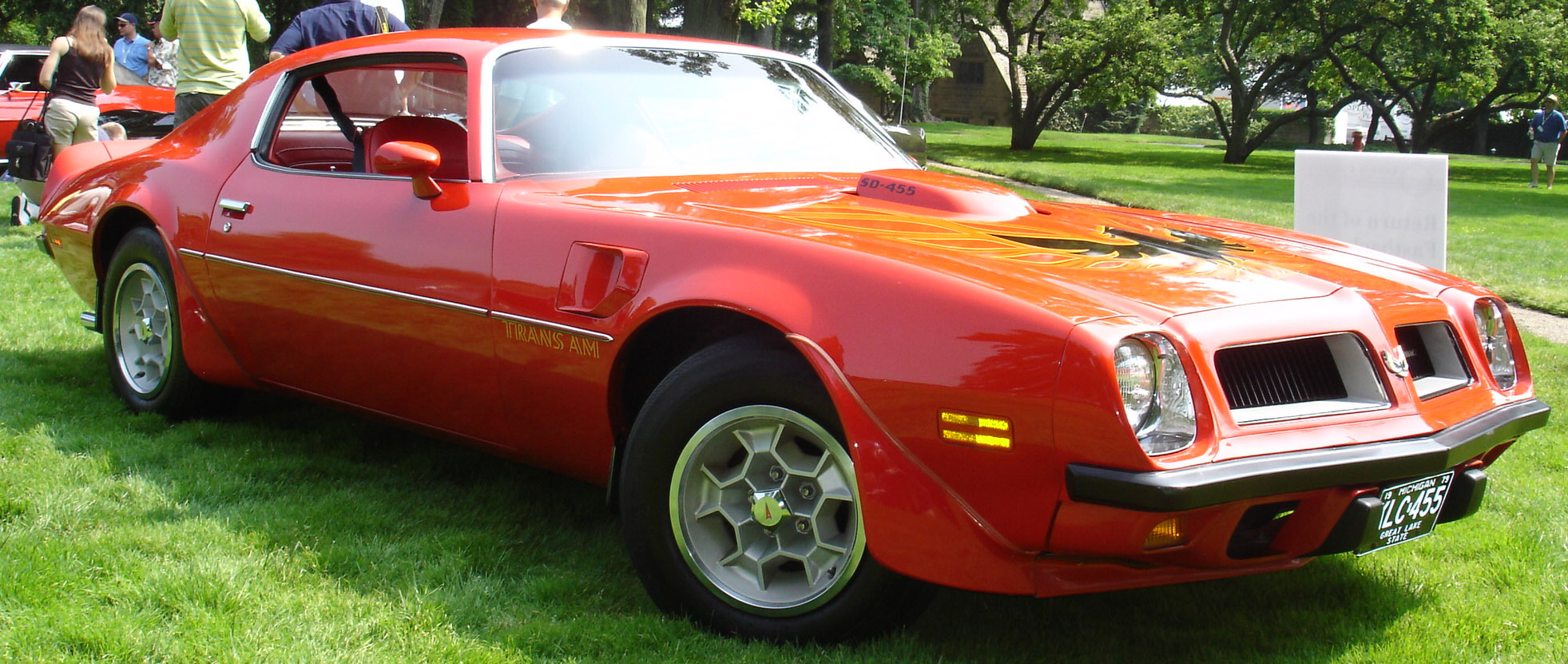
Pontiac continued the second generation Firebird from 1973–1976. For the 1973 Pontiac Firebird, the only noticeable exterior differences were to the front bumper and grille, and the interior which got nicer wood and removed the carpet. The 1974 Pontiac Firebird had a new front end again with a softer nose, and new rear tail lights that were fitted to a wrap-around bumper.
1975 saw the drop of a lot of the Firebird’s competition, as the Mustang, Camaro Z28, AMC Javelin, Plymouth Barracuda, and Dodge Challenger were all discontinued. This corresponded with a decent uptick in sales, but nothing drastic.
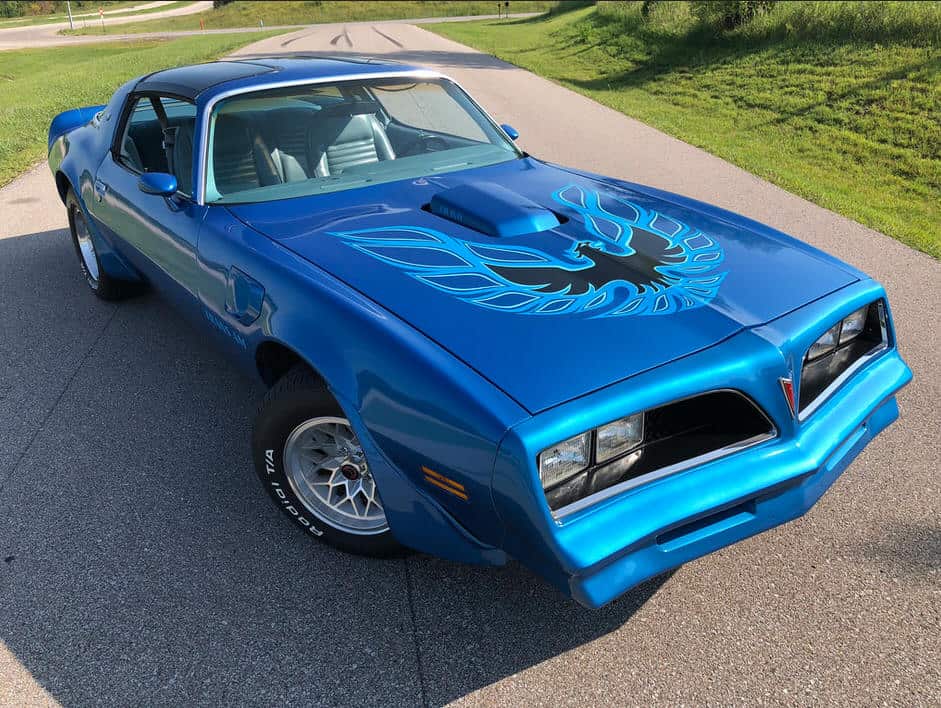
Power steering also became standard. Pontiac redesigned the front-end again for 1975–1976 Firebirds, including adding air-inlets in 1976 and a hexagonal mesh in the grille. For the Trans Am, Pontiac introduced the iconic hood decal in 1973, which was the WW7 option. This quickly earned the Firebird its “Screaming Chicken” nickname.
In 1976, a Pontiac 50th Anniversary Limited Edition Trans Am in black and gold was available, and 643 were T-Tops. In addition, they also had stripes, a gold hood decal, gold grilles and headlight bezels, gold polycast honeycomb wheels, a gold steering wheel, and 50th anniversary badge.
1973–1976 Pontiac Firebird Engine Technical Specifications
| Model Years | Engine | Horsepower | Torque | Engine Code |
| 1973-1975 | 250 cid I6 (1bbl) | 100 horsepower | 175 lb-ft | L22 |
| 1973 | 350 cid V8 (2bbl) | 150/175 horsepower | 270/280 lb-ft | L30 |
| 1973 | 400 cid V8 (2bbl) | 170/185 horsepower | 320/330 lb-ft | L65 |
| 1973 | 400 cid V8 (4bbl) | 230 horsepower | 325 lb-ft | L78 |
| 1973-1974 | 455 cid V8 (4bbl) | 250 horsepower | 370 lb-ft | L75 |
| 1973-1974 | 455 cid V8 SD | 290 horsepower | 390 lb-ft | LS2 |
| 1974-1975 | 350 cid V8 (2bbl) | 155/170 horsepower | 275/285 lb-ft | L30 |
| 1974 | 400 cid V8 (2bbl) | 190/200 horsepower | 330 lb-ft | L65 |
| 1974 | 400 cid V8 (4bbl) | 200 horsepower | 330 lb-ft | L78 |
| 1975 | 350 cid V8 (4bbl) | 175 horsepower | 285 lb-ft | L76 |
| 1975-1976 | 400 cid V8 (4bbl) | 185 horsepower | 315 lb-ft | L78 |
| 1975-1976 | 455 cid V8 (4bbl) | 200 horsepower | 330 lb-ft | L75 |
| 1976 | 350 cid V8 (2bbl) | 160 horsepower | 280 lb-ft | L30 |
| 1976 | 350 cid V8 (4bbl) | 165 horsepower | 260 lb-ft | L76 |
Engines, Transmission Options, and Performance
For the 1973 Pontiac Firebird, the big news was the introduction of the Super Duty 455 cid V8. The SD-455 made 290 horsepower and 390 lb-ft of torque and used the LS2 engine code. All SD-455’s were hand assembled, and had a reinforced block, dry-sump oiling provisions, special camshaft, aluminum pistons, oversize valves and header-like exhaust manifolds.
The cylinder heads were also high flow and had large exhaust ports. Originally, Pontiac rated the SD 455 at 310 horsepower, but they had to revise that to 290 horsepower after changing the camshaft specs to meet emissions standards. California buyers had several options made unavailable due to emissions restrictions, which included some of the 350/400/455 cid V8 engines.
For the 1973 L30 and L65 code V8s, the manual transmission versions made 15–25 horsepower more than the automatic versions. In 1974, Pontiac added the HEI electronic ignition to the L75, LS2, L65, and L78 code 400 and 455 V8s. Emissions restrictions forced Pontiac to reduce performance by the mid-1970s. The SD 455 was dropped in 1975, and for 1976 the highest output was the L75 code 200 horsepower 455 cid V8.
Transmissions available were a three-speed manual, two different four-speed manuals, and a Turbo Hydramatic automatic transmission. At first, the TH-400 was available, but this was dropped for the TH-350 in 1975, which could fit with the catalytic converter.
Production Numbers
| Model Year | Bodystyle | Production Total |
| 1973 | Base | 14,096 |
| Esprit | 17,249 | |
| Formula 400 | 10,166 | |
| Trans Am | 4,802 | |
| 1973 Total | 46,313 | |
| 1974 | Base | 26,372 |
| Esprit | 22,583 | |
| Formula 400 | 14,519 | |
| Trans Am | 10,255 | |
| 1974 Total | 73,729 | |
| 1975 | Base | 22,293 |
| Esprit | 20,826 | |
| Formula 400 | 13,670 | |
| Trans Am | 27,274 | |
| 1975 Total | 84,063 | |
| 1976 | Base | 21,206 |
| Esprit | 22,252 | |
| Formula 400 | 20,613 | |
| Trans Am | 46,704 | |
| 1976 Total | 110,775 |
Trans Am Production: For the 1973 Trans Am with the standard 455 V8, there were 4,550 buyers, of which 1,420 got manuals and 3,130 automatics. Of the 252 buyers who opted for the SD 455, 72 got manuals and 180 automatics. For the 1974 Trans Am, 4,664 buyers opted for the 400 cid V8, with 1,750 manuals and 2,914 automatics. That year, 4,648 opted for the standard 455 V8, all of which were automatics. The SD 455 buyers brokedown with 212 manuals and 731 automatics.
In 1975, the 26,417 opted for the 400 V8, broken down by 6,140 manuals and 20,277 automatics. That year, 857 buyers got the 455 V8, all of them manuals. For the 1976 Trans Am, 37,015 were the standard 400 V8, while 7,099 got the 455 V8. Another 1,628 got the limited edition Trans Am with the 400 V8, and another 310 got the limited edition 455 V8. Finally, 533 got the T-Top 400 V8 and 110 the T-Top 455 V8.
1977-1981 Pontiac Firebird
Pontiac continued the Firebird’s second generation from 1977–1981, when it ended. For the 1977 Firebird, Pontiac gave the front-end new dual rectangular headlights and a redesigned hood with new lower profile hood scoops. In 1979, Pontiac once again gave the Firebird a facelift, which included new headlights, grille, and hood.
Pontiac continued the Trans Am from 1977–1981, and carried over the T-Tops from 1976. In 1978, the WS6 performance package became available, which included gold snowflake wheels, 70R15 radial tires, and a thicker rear-sway bar.
In 1977, the Trans Am became synonymous with Burt Reynolds character from “Smokey and the Bandit,” causing it to skyrocket in popularity. In addition, several special editions came out, including the Blue “Sky Bird” and “Red Bird” packages.
For 1979, the W50 Formula appearance package was available with a rear deck-lid spoiler. This year, a 10th anniversary Trans Am package was also made available. It had pretty much every option available, and special decals and badges. The 10th anniversary Trans Am became the pace car for that year’s Dayton 500. In 1980, the Turbo Trans Am was the Indy Pace Car, which had the WS6 appearance package.
Pontiac ended the second generation with the 1981 Firebird, moving to the third generation in 1982.
1977–1981 Pontiac Firebird Engine Technical Specifications
| Model Years | Engine | Horsepower | Torque | Engine Code |
| 1977-1979 | 231 cid V6 (2bbl) | 105 horsepower | 185 lb-ft | LD5 |
| 1977 | 301 cid V8 (2bbl) | 135 horsepower | 235 lb-ft | L27 |
| 1977 | 350 cid V8 (4bbl) | 170 horsepower | 275 lb-ft | L34 |
| 1977 | 350 cid V8 (4bbl) | 170 horsepower | 280 lb-ft | L76 |
| 1977-1978 | 400 cid V8 (4bbl) | 180 horsepower | 325 lb-ft | L78 |
| 1977 | 400 cid V8 (4bbl) | 200 horsepower | 325 lb-ft | W72 |
| 1977-1979 | 403 cid V8 (4bbl) | 185 horsepower | 325 lb-ft | L80 |
| 1978-1979 | 5.0 L V8 (2bbl) | 135 horsepower | 235 lb-ft | LG3 |
| 1978-1979 | 5.7 L V8 (4bbL) | 170 horsepower | 275 lb-ft | LM1 |
| 1978 | 6.6 L V8 (4bbl) | 220 horsepower | 320 lb-ft | W72 |
| 1979 | 4.9 L V8 (2bbl) | 140 horsepower | 235 lb-ft | L27 |
| 1979 | 4.9 L V8 (2bbl) | 150 horsepower | 250 lb-ft | L37 |
| 1979 | 6.6 L V8 (4bbl) | 220 horsepower | 320 lb-ft | L78 |
| 1980-1981 | 3.8 L V6 (2bbl) | 115 horsepower | 188 lb-ft | LD5 |
| 1980 | 4.9 L V8 (2bbl) | 140 horsepower | 220 lb-ft | W72 |
| 1980-1981 | 4.9 L V8 (2bbl) | 170 horsepower | 230 lb-ft | L37 |
| 1980-1981 | 4.9 L V8 Turbo | 210 horsepower | 345 lb-ft | LU8 |
| 1980-1981 | 5.0 L V8 (4bbl) | 150 horsepower | 230 lb-ft | LG4 |
| 1981 | 4.3 L V8 (2bbl) | 120 horsepower | 210 lb-ft | LS5 |
Engines, Transmission Options, and Performance
For the 1977 Pontiac Firebird there were several new additions. The smallest was a Buick-built 231 cid (3.8 liter) V6 that made just 105 horsepower. Other non-Pontiac engines for 1977 included both 350 and 403 cid V8s from Oldsmobile. In 1978, the majority of the engines were non-Pontiac, and this Pontiac started to list engines in terms of liters instead of cubic inches, as part of the federal push towards the metric system, which never ended up happening.
For 1978, non-Pontiac engines included a 3.8L V6 and 5.7L V8 from Buick, both 5.0L and 5.7L V8s from Chevrolet, and both 5.7L and 6.6L V8s from Oldsmobile. Through 1979, the highest output engine was the W72 code 6.6 L V8, which made 220 horsepower in 1978, but was replaced by the L78 engine code (220 horsepower) in 1979. For 1980, Pontiac introduced a new 3.8 L V6 from Buick that made 115 horsepower.
That year there were three different 4.9 L V8s available, the W72, L37, and LU8. Of these, the most publicized was the LU8, which was turbocharged. It made 210 horsepower and 345 lb-ft of torque, and had a bulge on the hood to accommodate the turbo. However, performance was terrible, as there was no boost gauge and lag was extreme. In addition, many would start to knock heavily under load and blow-up from running lean.
Production Numbers
| Model Year | Bodystyle | Production Total |
| 1977 | Base | 30,642 |
| Esprit | 34,548 | |
| Formula 400 | 21,801 | |
| Trans Am | 68,744 | |
| 1977 Total | 155,735 | |
| 1978 | Base | 32,671 |
| Esprit | 36,926 | |
| Formula 400 | 24,346 | |
| Trans Am | 93,351 | |
| 1978 Total | 187,294 | |
| 1979 | Base | 38,642 |
| Esprit | 30,853 | |
| Formula 400 | 24,850 | |
| Trans Am | 117,108 | |
| 1979 Total | 211,453 | |
| 1980 | Base | 29,811 |
| Esprit | 17,277 | |
| Formula 400 | 9,356 | |
| Trans Am | 50,896 | |
| 1980 Total | 107,340 | |
| 1981 | Base | 20,541 |
| Esprit | 10,938 | |
| Formula 400 | 5,927 | |
| Trans Am | 33,493 | |
| 1981 Total | 70,899 |
Trans Am Production:
For the 1977 Trans Am, there were once again three options: the standard, special edition, and special edition T-Top. The standard and special edition got either the L78 or W72 400 V8s, while the T-Top included the L80 403 V8. L78 buyers are broken down as follows: 29,313 standard, 748 special edition, and 6,030 T-top. W72 buyers were: 18,785 standard, 933 special edition, 6,459 T-Top. Finally, L80 buyers were: 5,079 standard, 180 special edition, 1,217 T-Top.
For the 1978 Trans Am, L78 buyers included 63,812 standard, 3,433 black special editions, and 7,796 gold special editions. W72 buyers: 8,251 standard as it was not available in the other packages. L80 buyers: 8,969 standard, 210 black special edition, 880 gold special edition.
For the 1979 Trans Am, standard buyers included 8,605 for the 301 cid V8, 2,485 for the 400 cid V8, and 48,488 for the 403 cid V8. T-Top buyers included 4,831 for the 301 cid V8, 2,917 for the 400 cid V8, and 30,728 for the 403 cid V8. Special edition T-Tops included 573 of the 301 cid V8, 1,107 of the 400 cid V8, and 9,874 of the 403 cid V8. 10th Anniversary Trans Am buyers were 1,817 for the 400 cid V8 and 5,683 for the 403 cid V8.
For the 1980 Trans Am four options were available: two 4.9 V8s, a 5.0 V8, and the Indy Pace Car with the turbo V8. Standard 4.9L V8 buyers were 25,714, with 16,476 turbo buyers. There were 3,006 buyers of the 5.0 V8, and 5,700 got the Indy Pace Car with the 4.9 turbo.
For the 1981 Trans Am, 10,877 got the standard 4.9L, 13,578 the 4.9L Turbo, 7,038 the 5.0 V8, 2,00 the NASCAR 4.9L Turbo Pace Car.
1967-1981 Pontiac Firebird Legacy
The first two generations of the Pontiac Firebird were big hits. Introduced in 1967 and lasting until 1969, the first generation brought the Firebird to the public as Pontiac’s pony car entry. It competed alongside the Ford Mustang and Chevrolet Camaro (among others), and more than held its own. While production never reached the highs of either the Mustang or Camaro, they were still respectable for the Firebird.
The second generation lasted from 1970–1981, and saw the Firebird start to deal with the emissions crisis. They were still some of the most powerful American V8s available, but that didn’t mean much when power could barely creep across 200 horsepower. The turbo-Trans Am in 1980–1981 was a great novelty, but real performance was still going to be lacking for years.
Make sure to check out our 1982–2002 Pontiac Firebird article to see third and fourth generation specs and information.
*Thanks to Peter C. Sessler’s “Firebird Red Book” for production, option, and engine information.